$$PLAIN_TEXT_PREVIEW$$

The newest episode of our podcast is up!

Photo by Ana Lamata


Miscellany | 17.10.25

To compliment, rather than mould.

Every once in a while, Kavita will send out one or two articles that she’s recently become obsessed with to everyone and anyone who’d read them.

This week had one about what the author termed the ‘second skin’ of five (clothing). The piece is a nice read, though more than a bit dated as it was put up in the 50s.

Off the back of posting our last podcast episode with Ana Lamata, where the two talked about and showed how hats were commonly moulded on a head by head basis; both brought forward something we’ve been grappling with for a while now.

Nothing is really made to measure anymore.

VIP Patron Pass

€555.00

 SUPPORT US! 
 

Ever since the consumer fashion industry passed from a system of personal commissions to military uniform-like mass production of singular patterns; we’ve massively simplified the shapes & dimensions in which our clothes are made.

Sleeves cut differently on each person’s body, the width of someone’s shoulders defines the fall of a shirt, and looking through Ana’s measurement booklet shows quickly that there is no head on earth that has that perfect oval shape.

But shirts, blouses, pants, and even way more variable things like shoes and hats are today cut in a single set of dimensions varied by size: Small, medium, and large.

While this might’ve made sense in the 1800s when the population of Europe grew by an order of magnitude, today, when we produce so much it’s actively hurting us, it somehow appears as both wasteful and austere.

Shoes produced in orders of tens of thousands, made in the shape of a ‘general’ or ‘normal’ foot, fit uncomfortably to different people as the narrowness at the heel, or the arch of the boot mould the person into their shape.

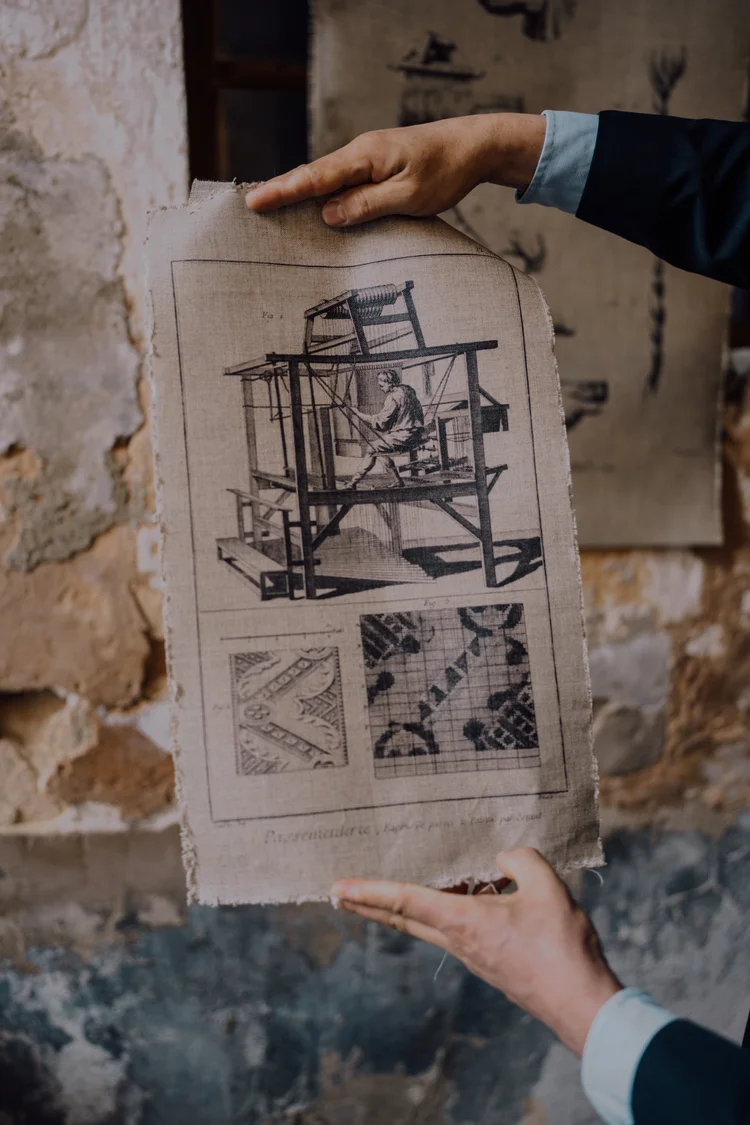
Photo by @engelenegle of art by Martin Palacion Ylätalo


Some Foucault-type would have a field day with that as an analogy, but in practical terms it's uncomfortable, it hurts, and it makes walking or moving around more strenuous than it needs to be.

The fashion industry’s answer to this problem so far has been to flood the market awash with so many products that, at some point, one of them has to fit you. And that has seeped well into the public consciousness.

If you’ve ever suggested to someone not in the industry, that they get their day-to-day outfits fitted you will get looked at like some out-of-touch billionaire.

In the age where the rich doing their darnest to look anything but, tailoring has been isolated to the most formal of formal wear. For big fancy business party suits, wedding tuxedos and dresses.

Unconsciously broader society understands that for these big, life altering events we must look our best, and that our best we look when the clothes that we wear were created to compliment our figure.

Photo by @engelenegle of hats by Ana Lamata


The industrial mill tore through Europe’s weavers like a plague, and the slow off-shoring of any productive industry away from our continent’s barely living wages has methodically killed whatever was left.

Work that was prized, highly skilled, and made to serve its local community was eroded for larger quantities of almost entirely worse quality goods.

General wear is probably not going to be overtaken by artisan production any time soon, but the world of luxury fashion larger than it has ever been is prime ground for this. If Luxury fashion’s saving grace is that it is the place where the envelope is pushed, then its future could well be tailor-made.

Photo by @engelenegle of art by Martin Palacion Ylätalo


When I go down to my nearest coffee shop, this small business can serve a flat-white whose espresso has been filtered through a whirring 5000€ steel machine made in four different countries, and which is made with coffee gruellingly harvested from a community six thousand kilometers across the ocean, all for under three euro.

It’s hard to buy the notion that scaling down and beginning to recreate the industry of local tailoring is out of reach for our society’s productive capacity; not when mountains of polyester tat carves the vistas of subsaharan Africa like mountain chains.

So why not have a tailor on every block, in place of a fast fashion store. Or a shoemaker rather than the same five brand stores?

Even the biggest novice can’t do worse than what my current boots do to my f***ing feet.

Also in marco-economic terms, more high skilled creative industry jobs, win-win right?

If you’re interested in subjects like these you might be the perfect candidate for our leadership program, give it a look!

Photo by @engelenegle of the Arquinesia store in Palma

 
 WATCH EPISODE 5 OF OUR PODACST 

Please follow our podcast on YouTube and Spotify!


XTANT, Calle Sanchez Pacheco 47, Callejon Local 1, Madrid, 28002, Spain

Unsubscribe